Research lab · Kean University

NACRE Lab

Neural Architectures Co-evolved
for Resource Efficiency

We grow neural architectures instead of hand-designing them: evolutionary search discovers compact recurrent models for time series forecasting, small enough to run on the device where the data is generated, yet competitive with architectures many times their size.

An RNN architecture evolved by EXAMM
What we work on

Research directions

The lab's work spans five connected areas: evolutionary neural architecture search, time series forecasting, online forecasting with ONE-NAS, cross-disciplinary edge AI applications, and AI education.

01

Evolutionary Neural Architecture Search

We develop neuroevolution methods that automatically design recurrent neural networks, with a focus on discovering compact architectures that rival much larger hand-designed models. The emphasis is on ultra-lightweight designs suitable for edge deployment, where memory, power, and latency constraints rule out conventional deep learning pipelines.

neuroevolution RNN design edge AI
EXAMM Neural Architecture graph

EXAMM Neural Architecture

02

Time Series Forecasting

We design forecasting models for multivariate time series, using evolved recurrent networks that stay compact while remaining competitive with far larger architectures. Applications include industrial sensor data from coal-fired power plant operations and financial markets.

In finance, we use both EXAMM and ONE-NAS to predict stock returns, and build portfolio management strategies on top of the resulting predictions.

multivariate time series stock return prediction portfolio management industrial sensor data
An RNN architecture evolved by EXAMM for stock return forecasting

An RNN evolved by EXAMM for stock return forecasting

03

Online Time Series Forecasting with ONE-NAS

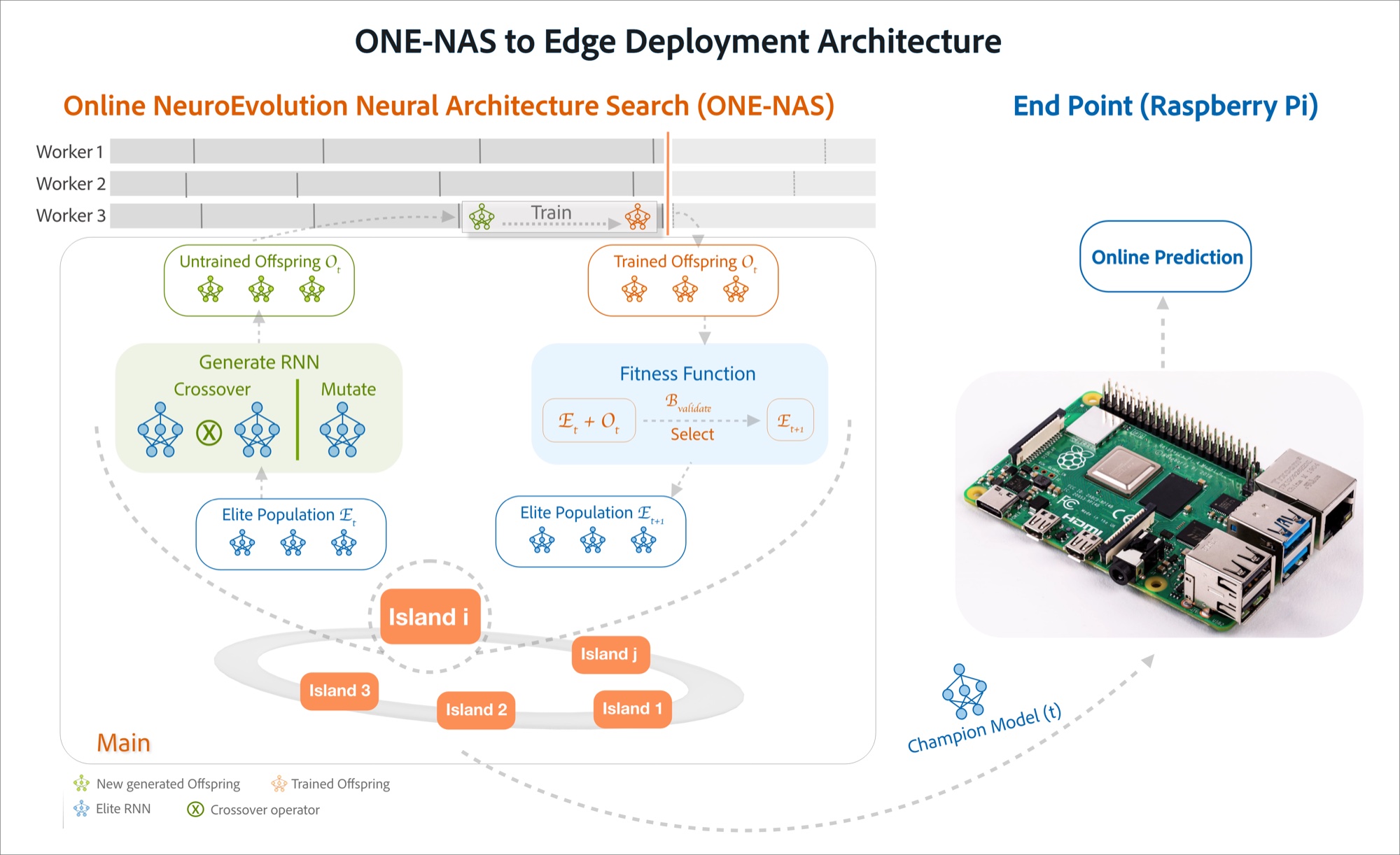
ONE-NAS (Online NeuroEvolution-based Neural Architecture Search) searches for and trains recurrent networks while the data is still arriving. Rather than searching once on a fixed historical dataset, it keeps evolving populations of RNNs on distributed islands as new observations stream in, and the best model found so far makes each new prediction. The forecaster can therefore adapt its architecture, not only its weights, when the data distribution shifts.

online learning non-stationary data island-based neuroevolution
ONE-NAS online neuroevolution workflow

ONE-NAS: online neuroevolution for time series

04

Cross-Disciplinary Edge AI Applications

A growing line of our work applies neuroevolved lightweight models to domains outside traditional ML benchmarks, partnering with researchers in engineering, energy, and finance. The goal is forecasting and decision-support systems that run on the device where the data is generated.

One application brings ONE-NAS to the edge: the online search runs on a server, and each new champion model is sent to a Raspberry Pi, which makes online predictions on the device itself.

applied ML interdisciplinary collaboration resource-constrained inference
ONE-NAS to edge deployment: champion models sent to a Raspberry Pi for online prediction

ONE-NAS deployed to a Raspberry Pi for on-device online prediction

05

AI Education & Pedagogy

We research how to broaden AI literacy beyond computer science majors. The lab runs the Kean Cup AI Competition as a venue for students across disciplines to work on applied AI projects, and leads an AI research stream in the Group Summer Scholars Research Program for high school students. This line of work explores curriculum design, assessment, and the pedagogy of AI for non-specialists.

AI literacy interdisciplinary education outreach
Earlier work

Previous research

Previous

Minimally Supervised Learning with Self-Organizing Maps

Labeling data is often the most expensive part of applying machine learning. This work trains a self-organizing map on unlabeled data and then relies on only a small set of labeled points: each new sample is mapped to its best-matching unit, and its value or class is estimated from the nearest labeled units using graph distances across the map's topology. We applied these topological projections to both regression and classification, including phase-of-flight identification from flight data, and studied how to choose which samples to label by clustering the map's embeddings.

self-organizing maps minimal supervision flight data
Self-organizing map topological projections for regression

SOM topological projections for regression

Members

People

Current Members

  • Jonathan Chang Union County Magnet High School
  • Marvin Ayala Kean University
  • Timothy Nguyen Kean University
  • Diego Lopez Kean University
  • Estefania Roca Serrano University of Puerto Rico, Mayagüez

Past Members

  • Alejandro Perdomo New Jersey Institute of Technology
NACRE Lab Kean University

Department of Computer Science and Technology, Kean University, Union, New Jersey.